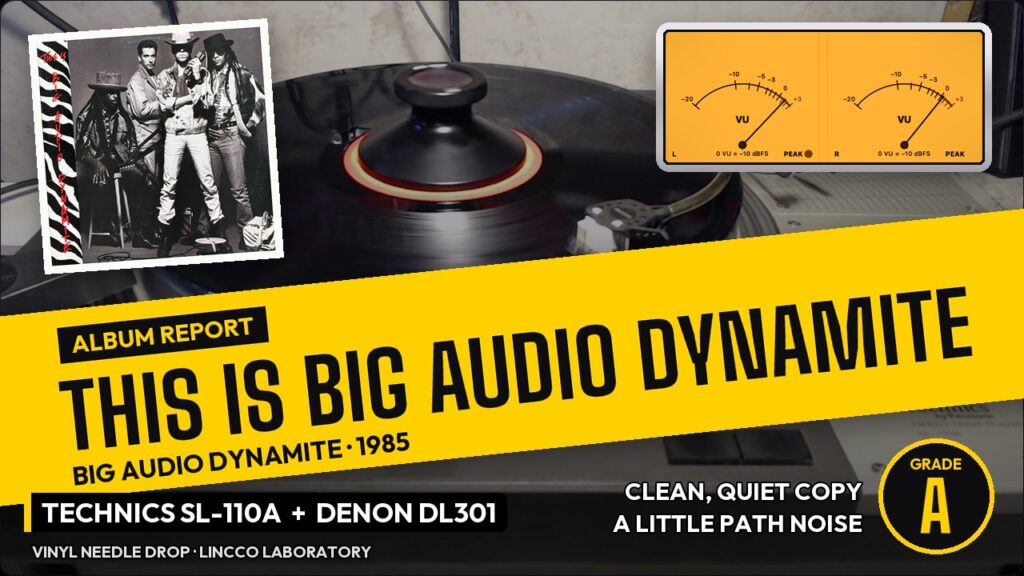
Big Audi Dynamite – This Is Big Audio Dynamite – Side A – Album Test Report

PATH CHECK · ALBUM REPORT
Big Audio Dynamite — This Is Big Audio Dynamite
Columbia · BFC 40220 · US · 1985
Electronic, Rock, Leftfield, Electro, Synth-pop
Sides tested: A · 2026-11-24
At a glance
- The record: mostly A (excellent) for sound, lowest track B.
- Dynamics: about DR11 on average — good contrast between loud and soft.
- The gear: Usable, with something to look at (path check 2026-11-24).
- In a sentence: A clean, quiet copy, played on a path with a little noise.
Track by track
Side A recorded 2026-11-24 · 96 kHz / 24-bit
| Track | Length | Sound | Surface noise | Pops | Crackle | Warp | Dynamics | |
|---|---|---|---|---|---|---|---|---|
| A1 | Medicine Show | 6:17 | A | Very quiet surface (A)54.5 dB · grade A | Almost no pops (A)0 per minute · grade A | No crackle to speak of (A)0.0 per second · grade A | Slight warp-24 dB vs music · grade B | somewhat compressed (DR10)-14.77 LUFS · LRA 5.58 LU |
| A2 | Sony | 4:26 | B | Very quiet surface (A)54.3 dB · grade A | Regular pops (C)4 per minute · grade C | No crackle to speak of (A)0.3 per second · grade A | Steady — no sign of a warp-27 dB vs music · grade B | good loud-to-soft contrast (DR13)-15.48 LUFS · LRA 4.86 LU |
| A3 | E=MC² | 5:54 | A | Quiet surface (B)48.7 dB · grade B | Almost no pops (A)1 per minute · grade A | No crackle to speak of (A)0.1 per second · grade A | Steady — no sign of a warp-29 dB vs music · grade B | good loud-to-soft contrast (DR12)-14.46 LUFS · LRA 4.27 LU |
| A4 | The Bottom Line | 4:34 | B | Quiet surface (B)49.1 dB · grade B | Almost no pops (A)2 per minute · grade A | Light crackle (B)0.9 per second · grade B | Steady — no sign of a warp-25 dB vs music · grade B | — |
Surface noise needs a quiet stretch of bare groove; each track is measured from the gap before it (the lead-in for the first track). Dots: green good, amber fair, red poor, grey not measured.
The gear
- CARTRIDGEDenon DL301
- TURNTABLETechnics SL-110a
- PHONO PREAMPFosi X5
- AMPYamaha RX-V870
- RECORDED WITHFocusrite Scarlett 2i2
The path’s own test (arm up, nothing playing — 2026-11-24): Usable, with something to look at
- Noise floor (A-weighted): Quiet — you won't hear it L -84.8 / R -87.1 dBFS
- Hum: Faint hum — only with the volume well up Slight · -75 dBFS (mostly 60 Hz)
- Noise difference left/right: Both sides equally quiet 2.3 dB (left noisier)
How we tested — the plain version
- The capture. The record plays through the gear above into the audio interface at 96 kHz / 24-bit, saved as lossless FLAC. No EQ, no click removal, no noise reduction — what the needle picked up is what was measured.
- Two kinds of test. The path check listens to the gear on its own, arm up, so its hiss and hum can’t be blamed on the record. The album check listens to the record playing, so what’s left is the disc: its surface, pops, crackle and warp.
- Noise floor (A-weighted). The hiss and hum your equipment makes on its own, with the arm up and nothing playing. A-weighting counts it the way your ear hears it: deep bass and the very top treble count less, because the ear is less sensitive there. Lower (more negative) is quieter. Below −80 dBFS is quiet; above −65 you may hear hiss in quiet passages. For scale, a perfect 16-bit recording can't go below about −98 dBFS.
- Hum. A steady buzz from the mains power: 60 Hz in North America (50 Hz in most other places) plus its multiples, 120 and 180 Hz. It usually gets in through grounding — a missing turntable ground wire, or a ground loop, where two boxes are connected to ground in more than one place. 'None found' is ideal. 'Slight' is usually only audible with the volume turned well up between tracks. 'Noticeable' or 'Strong' you'll hear on the recording.
- Noise difference left/right. Whether one channel is noisier than the other with nothing playing. Under 3 dB is normal — the two sides of most gear differ a little. Bigger differences usually mean one cable, plug or channel has a problem.
- Music to surface noise. How much louder the music is than the record's own background hiss, measured in the quiet groove (ideally the lead-in before the music). It's the vinyl version of 'signal to noise'. Higher is better. 50 dB or more is an A — a very quiet surface. Around 40 dB you'll hear hiss in soft passages; below 32 dB it's noisy all the way through.
- Clicks. Pops you can hear above the music — usually dust, a scratch, or a flaw in the pressing. Ticks that the music drowns out aren't counted, because you won't hear them. 5 or fewer a minute is an A — you'd have to listen for them. Over 40 a minute is a record that pops regularly.
- Crackle. Faint, frequent ticking just above the music — the 'frying bacon' sound of dust and groove wear. Smaller than a click but many more of them. Half a tick a second or less is an A. Several a second is crackle most people will notice in soft passages.
- Subsonic (warp / arm). Very low-frequency movement, below what you can hear. It comes from two places: a warped or off-centre record, which rises and falls with every turn, and the tonearm and cartridge bouncing at their natural frequency, which stays steady. Path Check tells them apart and only counts the turn-by-turn kind against the record. Lower (more negative) is better. Steady energy around 7–13 Hz is the arm and cartridge, and that range is where makers say it should be.
- Dynamic range (DR). The well-known 'DR number'. It splits the music into 3-second pieces and compares the peaks with the loudness of the loudest fifth of the pieces. A squashed master has peaks only a little above its average, so a small number. Roughly: DR14 and up is very open; DR11–13 good; DR8–10 somewhat compressed; DR7 and below heavily compressed. An album's DR is the average of its tracks.
- Loudness range (LRA). How far the loudness moves between the quieter and louder sections of the music, ignoring the very quietest 10% and the loudest 5% so a fade-out or one big hit doesn't skew it. Clicks don't affect it, so it's a fair way to compare vinyl with digital. It depends on the music: often under 6 LU for rock and pop, 10–20 LU or more for classical and film. Compare versions of the same album.
- Loudness (LUFS). The average loudness of the whole recording, measured the way people hear it. It's the modern standard used by broadcasters and streaming services. There's no 'good' value — but very loud masters (around −9 LUFS or louder) almost always had their dynamics squeezed to get there. Many older CDs sit around −15 to −20.
- What the grades mean. Each album check gets two grades. SOUND is what you'll hear: surface hiss, clicks and crackle. CONDITION is the disc itself: whether it's warped or off-centre. A record can sound great and still be warped, or be flat and noisy. A is excellent, B good, C fair, D poor, F bad. For digitizing, A or B on Sound is a good candidate as it is.
References & where the numbers come from
Each source says what kind it is, so you know how much weight to give it.
- Industry standard A-weighting is defined in the IEC 61672 sound-level-meter standard. Wikipedia: A-weighting
- Textbook fact Each bit of a recording is worth about 6 dB, so 16-bit ≈ 96–98 dB below full scale. Wikipedia: Audio bit depth
- Textbook fact Mains hum is at the power-line frequency and its harmonics. Wikipedia: Mains hum
- Manufacturer guidance Rane (pro-audio maker), Note 110: ground loops happen when two units' grounds are tied together in a second place. Fix with proper wiring or an isolation transformer; lifting a safety ground is a last resort. ranecommercial.com — note110.html
- Industry standard For comparison, the RIAA standard allows surface noise 55 dB below a 1 kHz test tone (cited by R. Bauman, Audio Electronics, 1996). Path Check measures against the music instead of a test tone, so the numbers aren't directly comparable. analogplanet.com — vinyl-dynamic-range.pdf
- Textbook fact A loud sound hides quieter sounds near it in pitch and time (auditory masking), which is why only clicks that rise above the music count. Wikipedia: Auditory masking
- Manufacturer guidance Ortofon: tonearm/cartridge resonance between 7 and 12 Hz is optimal (10 Hz recommended). ortofon.com — find-the-right-cartridge
- Manufacturer guidance Audio-Technica: keep the resonance between 9 and 13 Hz. docs.audio-technica.com — Cartridges_Glossary_EN.pdf
- Textbook fact At 33⅓ rpm one turn takes 1.8 s, so a warp repeats 0.56 times a second — that's how Path Check spots it.
- Industry standard The DR method published with the Pleasurize Music Foundation's DR meter (3 s blocks, second-highest peak, loudest 20 %). sound.bai-hua.org — Measuring_DR_ENv3.pdf
- Rule of thumb The DR14 / 11 / 8 bands are a common reading of the scale, not part of a standard. Vinyl rips often read higher than digital versions. headphonesty.com
- Industry standard EBU Tech 3342: 3-second windows, gated at −70 LUFS and 20 LU below the average, 10th to 95th percentile. tech.ebu.ch — tech3342.pdf
- Industry standard ITU-R BS.1770 loudness, as used by EBU R 128 (gates at −70 LUFS and 10 LU below the average). Wikipedia: EBU R 128
- Manufacturer guidance Spotify normalizes playback to −14 LUFS. support.spotify.com — loudness-normalization
- Path Check's own grading Path Check's grade boundaries. There's no published standard for this, so they were set by checking records whose sound we already knew, and they may be retuned as more records are tested.
- The −80 / −65 dBFS boundaries.
- The None / Slight / Noticeable / Strong levels (−85, −70, −55 dBFS).
- The 3 dB / 6 dB boundaries.
- The A–D grade boundaries (50, 44, 38, 32 dB).
- How far above the music a click must rise (22 dB), and the grade boundaries (5, 15, 40, 100 per minute).
- What counts as crackle (14–22 dB above the music) and the grade boundaries (0.5, 2, 6, 15 per second).
- The grade boundaries (−30, −20, −12, −6 dB below the music).
- How the individual results combine into a grade.